
Introduction
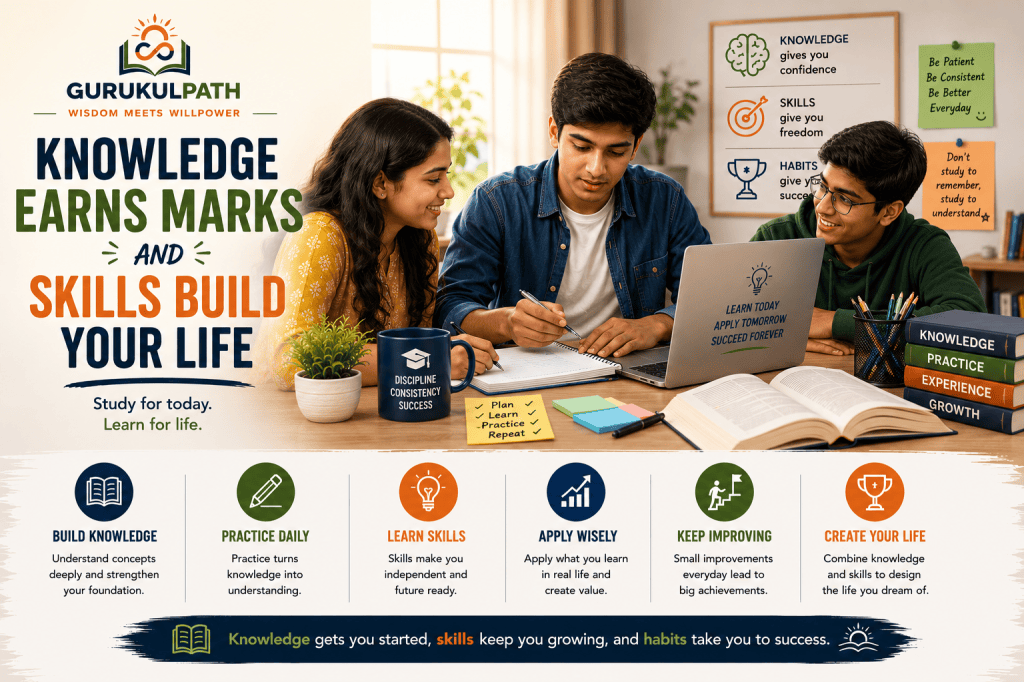
When we start our schooling, everyone—whether parents or students—has one simple goal: to achieve the best marks. We work hard in every subject, which gives us knowledge, and that knowledge helps us earn good marks. Good marks are very important as they reflect our learning, discipline, and overall academic performance.
However, life after school and college demands much more than marks, and here comes another important factor in life—skills. Marks are a representation of the knowledge we have gained, while skills are the practical implementation of that knowledge and potential. Therefore, both complement each other and are equally important for a successful and meaningful life.
1. Knowledge Builds a Strong Foundation
Studying is one of the most essential parts of our life. Studies help us achieve good marks, and marks become the foundation of our future. We need to study our academics, that is, the syllabus provided, in a detailed way to understand the meaning behind it. This makes learning easier to remember, helps us gain knowledge, and enables us to score better in academics.
A strong foundation is necessary to build higher skills. For example, the base of any triangle is essential because we cannot construct a triangle without a baseline. By making the base stronger, we can reach the peak point of the triangle. Similarly, our life follows the same principle. We can achieve the highest points in life by strengthening our knowledge and developing strong skills.
Learning should never be ignored because it helps us stand firm in every circumstance of life. Learning does not mean only academics; it also includes life skills, technical knowledge, and our own past experiences. Everything is a crucial part of our life. A learning mindset is the key factor that helps us keep growing throughout life.
2. Skills Bring Knowledge into Action
Knowledge alone is incomplete without bringing it into practical application. Knowledge is potential, and skills are the practical application of that potential. For example, theoretical knowledge alone is not sufficient to construct a building; practical skills are equally important. Skills transform knowledge into reality. Here are some more examples for better understanding:
Communication Skills
Learning the basics, understanding how to speak, and knowing the principles of communication are forms of knowledge. Having meaningful, clear, and understandable communication with others is the skill.
Decision-Making Skill
We may have knowledge in many fields such as cooking, technology, fitness, or healthy habits. However, knowing something is different from deciding when and where to apply it. Choosing the right idea or solution for a particular situation is called decision-making, and this skill helps us grow in every area of life.
Time Management
Managing time has become a common challenge nowadays, and everyone knows how important it is. Imagine you have many tasks to complete in a single day. Planning them properly, prioritizing them, and completing them one by one according to the situation is the true skill of time management.
3. Marks Open Opportunities
Good marks are the first step towards success in many areas of our life. Just as we need to climb the first step to reach the terrace, good marks play an important role in getting shortlisted for many opportunities.
For example:
- Students gain admission, scholarships, and initial career opportunities through good marks.
- Job seekers are often shortlisted based on their academic results, which are reflected through their marks.
Marks create opportunities to begin, but they do not guarantee long-term success. To sustain continuous growth and success in life, skills play a major role.
Always work sincerely to achieve good marks in academics and respect their importance because they are the key that opens the lock of success. Though the key may look very small, without it you cannot unlock the door and enter the room.
4. Skills Help You Grow Throughout Life
Once an opportunity is received, skills determine our future growth. The skills that play a major role in sustaining growth are adaptability, time management, leadership, communication, and continuous learning.
- Adaptability :
Helps us work under any circumstances, whether in our favor or not. It removes resistance from life and helps us grow continuously.
- Leadership :
The ability to guide and grow with a team. It teaches us that growing together builds trust and makes life easier.
- Communication :
Communication is one of the qualities that helps us express our thoughts and vision clearly. It also teaches us to become good listeners because communication is not only about conveying our messages but also about listening to the ideas and thoughts of others.
- Continuous Learning :
Continuous learning is the fuel required for success throughout our life. It keeps us updated with new knowledge and technologies. Learning from experiences and accepting feedback creates a positive environment that ultimately leads to success.
5. Balance Knowledge and Skills
Balancing knowledge and skills is as important as balancing a traditional weighing scale because unless both sides are equal, it becomes unbalanced. Just as a weighing scale can measure accurately only when both sides are balanced, our growth becomes stronger when knowledge and skills develop together. Neither of them can be ignored since both complement each other. Knowledge alone cannot provide more opportunities, and skills alone cannot sustain long-term growth. Ignoring studies while learning skills is not the right approach, and neither is ignoring skills while focusing only on academics. Scoring good marks reflects our consistency and discipline, while skills ensure that we can implement our knowledge practically. Therefore, both are equally important for growing as an individual.
Common Mistake
Many students believe that scoring good marks alone assures success, while others completely ignore academics in the name of learning skills. Both approaches are incomplete. As explained above, balancing knowledge and skills is equally important for continuous growth and overall development.
Conclusion
Knowledge and skills are partners, not competitors. Marks reflect your academic journey, while skills help you face life’s challenges confidently. Continuing to learn both inside and outside the classroom is essential for personal growth and achieving amazing results in every area of life.
Our life is not limited only to the classroom, where we focus on achieving good marks, nor is it limited only to the world outside the classroom. Therefore, always work on both together to build a better future.
Final Thought
Instead of asking yourself, “How many marks did I score?”, always ask yourself, “What skills did I develop while earning those marks?” Because knowledge may earn you marks, but the skills you build will shape the life you create.
 GurukulPath
Leave a Reply